
If you want to memorize more Scripture this year, the Psalms might be the single best place to start. As divinely-inspired prayers and songs, they give us language for praise, lament, confession, and thanksgiving. Storing up the Psalms in our heart yields a rich reward. They begin to saturate our prayers and shape us over the whole course of our Christian life.
But how should we internalize the Psalms? If you endeavored to systematically memorize one per month, it would take twelve years to get through the entire Psalter! The scope seems daunting, and this sense has hindered me from attempting to memorize very many psalms beyond Psalm 23.
This year I’m trying something a little different, and perhaps you’ll find it helpful.
Instead of trying to memorize entire psalms word-for-word, start by memorizing:
A key phrase or central theme from each one, and
The structure of the Psalter
When you hear a reference to Psalm 23, you probably think, "The Lord's my shepherd," and perhaps Jesus' words about being the Good Shepherd come to mind. You're familiar with the psalm and how it points to Christ, even if you haven't memorized it word-for-word.
Why not aim for similar familiarity with the rest of the Psalter? Instead of memorizing a handful of psalms word-for-word, internalize the opening line or a key phrase from a wider range of psalms.
Consider how the psalms are used in Scripture itself. The author of Hebrews draws on the theme of Psalm 8 without quoting it in full or even citing it: “It has been testified somewhere, ‘What is man, that you are mindful of him…’” (Heb. 2:6). When Jesus quotes Psalm 22 from the cross ("My God, my God, why have you forsaken me?"), he was drawing attention to the entire psalm and his messianic fulfillment of it. It was a common Jewish practice to cite the first verse in reference to the whole passage, and this was all it took to make abundantly clear Christ’s identity as the Messiah.
When Jesus quotes Psalm 22 from the cross, he was drawing attention to the entire psalm and his messianic fulfillment of it.
With this in mind, it seems eminently achievable to work through the Psalter in a year of daily Bible reading, capturing one phrase from each Psalm as you go. While memorizing entire psalms is valuable, knowing the theme of a psalm and its place in the overall structure of books is often more helpful than reciting it verbatim.
So what should you focus on from each psalm? Here are a few options:
Many psalms are immediately recognizable by their first verse. "The Lord is my shepherd" (Psalm 23). "O Lord, our Lord, how majestic is your name in all the earth" (Psalm 8). "Bless the Lord, O my soul" (Psalm 103).
Some psalms have a chiastic (symmetrical) structure, where the central verse or section contains the key theme. To use the same examples above, while the first line of Psalm 23 is most well-known, the central line of Verse 4 may better summarize the theme of the psalm: “For you are with me.”
Psalm 8 is another example of this beautiful symmetry. The outer frame praises God’s majestic name, while the center emphasizes the key theme of man’s glory as vice-regents with God despite our smallness in the cosmos. So when Psalm 8 is mentioned, it’s central theme should come to mind: “What is man that you are mindful of him?”
A: “O Lord, our Lord, how majestic is your name”
B: “Heavens declare God’s glory
C: Central theme — “What is man?”
B’: Man crowned with glory
A’: “O Lord, our Lord, how majestic is your name”
Many modern Bibles include short descriptive headings before each Psalm. These headings can help you categorize and recall the Psalms, and are especially great to memorize if you typically read from the same translation.
When you read a Psalm, ask yourself: "What's the one line or concept I want to carry with me?" Write it down. Repeat it a few times, and let it settle into your memory. Over time, these phrases will form a mental map of the Psalter.
I remember how amazed I was the first time I learned that the Psalms aren't a random collection, but are intentionally arranged. Knowing this structure deepens your grasp of individual Psalms and helps you see how they work together. So one way to internalize the Psalter is simply to memorize its structure!
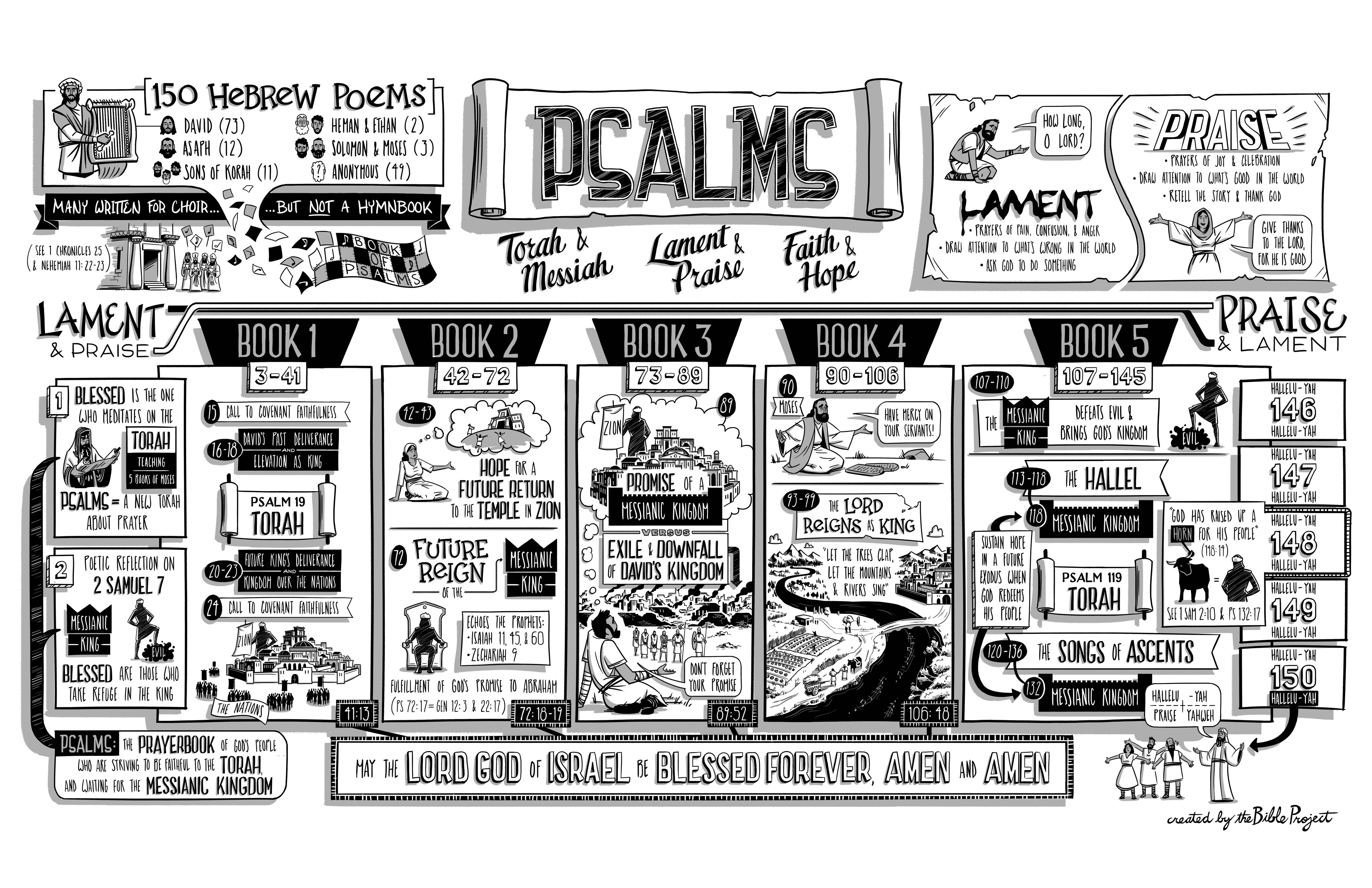
Source: The Bible Project
The Psalter is divided into five books (Psalms 1–41, 42–72, 73–89, 90–106, 107–150), each ending with a doxology. This five-fold structure mirrors the five books of Moses, presenting the Psalms as Israel's response to the Torah.
The Psalter as a whole tells a story. It moves from David's kingship through exile and suffering, and finally to the hope of a coming king who will reign forever. Psalm 2 speaks of God's anointed king. Psalms 89 and 90 mark a turning point of lament. The Psalter concludes with an explosion of praise in Psalms 145–150.
The Psalms are ultimately about Christ—his suffering, his vindication, his kingship, his people. This Christological reading unveils the Psalms' fullest meaning.
When you know this structure, individual psalm numbers start to mean something. Psalm 1 is the gateway to the entire collection. Psalm 72 is the climax of Book II, pointing forward to Christ. Psalm 150 is the culmination toward which the whole Psalter has been moving.
As Christians throughout history have understood, the Psalms are ultimately about Christ—his suffering, his vindication, his kingship, his people. This Christological reading unveils the Psalms' fullest meaning, and helps us pray and sing them more wholeheartedly.
If you’ve sat under good preaching for some time, and especially if your church sings the Psalms, you’ve probably internalized more psalms than you realize. So start with this simple exercise to map your current familiarity with the Psalter:
Don’t be discouraged if it’s a small fraction—think of what riches are hidden in the rest of the psalms, just waiting to be uncovered and hidden away in your heart!
Read through the Psalms over the course of a month or two—maybe five per day. As you read, jot down one memorable phrase from each psalm. Don't worry about picking the “right” phrase—simply capture what stands out.
At the end of each week, go back over the psalms you read and quiz yourself. Can you remember the key phrase for Psalm 14? Psalm 27? Some of the less popular ones will be tricky, so just refresh your memory and try again.
As you work through the Psalter, note where each book begins and ends. Pay attention to the themes that emerge in each section. You may also want to diagram the structure in your journal. The Bible Project has some really helpful resources on the structure of the Psalms here.
As you memorize key phrases, try to use them in your prayers. As you truly internalize themes and phrases from the Psalms, you may find they naturally start flowing out as you pray. If not, that’s okay too! Praying with your Bible open—especially to the Psalms—is always a good approach.
Internalizing a key phrase from each Psalm is a simple, sustainable way to build familiarity with God’s divinely-inspired songbook. Over time, this familiarity—when joined with faith—will deepen our affections for God and sustain us through the many changing scenes of life.
As the Puritan Thomas Watson wrote:
“The Scripture is both the breeder and feeder of grace. How is the convert born, but by 'the word of truth'? (James 1:18). How doth he grow, but by 'the sincere milk of the word'? (1 Peter 2:2).”
I’m going to try this approach in my reading this year, and I hope you’ll join me!