
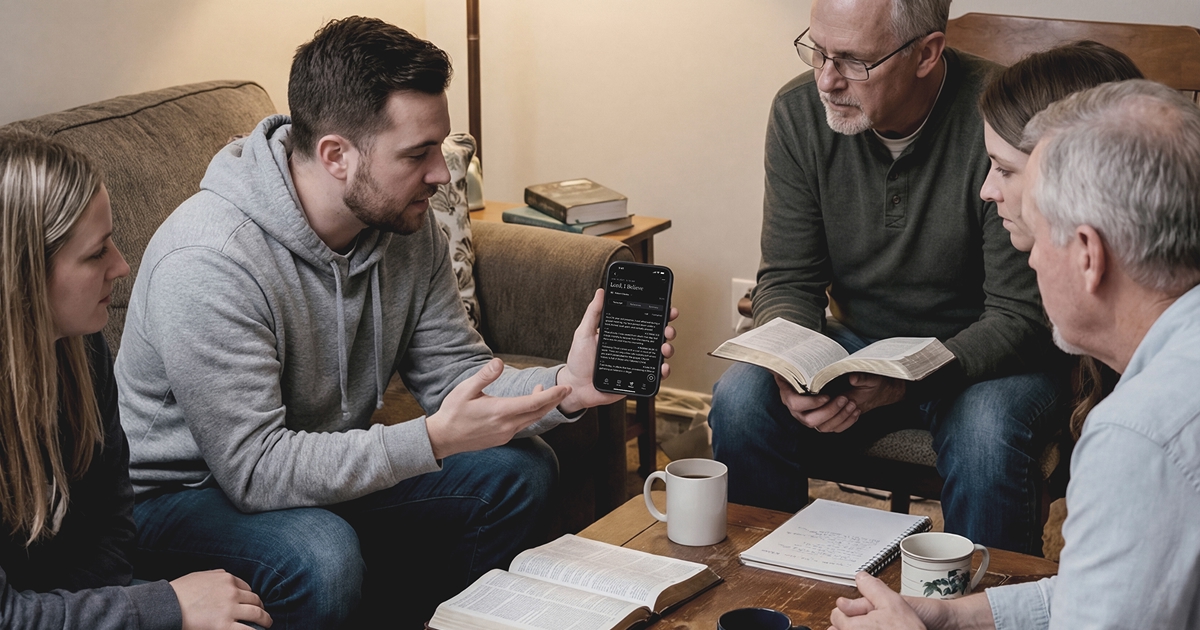
If you’ve ever been in a small group Bible study, chances are you’re familiar with awkward silence. Perhaps no question is more likely to result in awkward silence than this: “What did you think of the sermon on Sunday?”
One by one everyone around the room leans back and scratches their chin contemplatively. Maybe someone offers a vague comment: "I thought it was good." Another chimes in, “Yes, definitely a good sermon.” Someone else mentions a point they vaguely remember. The conversation stalls. After a few awkward moments, you move on to the study guide.
I've been in these moments. I often feel frustrated with myself, knowing that the sermon was filled with doctrinal depth and rich biblical meat—but not quite being able to recall or articulate much of it after the fact. I know I should be discussing the message with friends and family, but attempts at conversation seem to go nowhere.
Here is a simple approach that I’ve found helpful.
Rather than one open-ended question, try one of these five simple yet specific questions to stimulate thoughtful discussion around any sermon. You don't need to use all five every time. Pick two or three that make sense for your small group or family.
These questions move from observation to application, helping you review what was said, understand what it means, and figure out what to do about it.
This question does more work than you might think. Asking people to put the main point in their own words reveals how well they’ve understood the message. It also surfaces different perspectives—what seemed central to you might have registered differently for someone else.
If you can’t remember the main point at all, that’s okay! Having these discussions regularly will help everyone improve their retention over time.
Sometimes preachers state the main point clearly: "The big idea today is that God is sovereign over suffering." Other times you have to infer it from the text and the flow of the message. Either way, this question gets everyone on the same page before you go deeper.
Follow-up: Ask, "Why did that stand out to you?" The conversation often becomes richer when you explore why different people heard different emphases.
Scripture is God’s special revelation of himself. And the aim of preaching is not just to impart knowledge, but to set forth Christ in all his glory as the object of our worship. (Thus, listening to preaching is itself an act of worship.)
So don’t be afraid to get right to the God-centered core of a sermon. If the main point was about forgiveness, ask what the message revealed about God’s justice, mercy, patience, and the forgiveness secured for us by Christ.
Asking this question regularly also trains your small group or family in how to listen to preaching. You set the expectation that every sermon is a divinely-appointed opportunity to not only learn, but to behold our God.
Follow-up: "How does this aspect of God's character affect the way we live?" or "How does this truth about God comfort or challenge you right now?"
Conviction and encouragement are both works of the Spirit. When the Word is preached, the Spirit applies it to our hearts in specific ways. What cuts one person to the heart might sail past another. What brings comfort to you might not register with someone else.
This question lets people share what God is doing in them through the message. It also reveals spiritual needs within your group, enabling our prayers for one another to go deeper than the outward circumstances typically shared through prayer requests.
Follow-up: "Can we pray about that together right now?"
Good preaching connects one passage to the whole counsel of God, and this question invites your group to continue making those connections.
Maybe the sermon was on Philippians 4:6–7 and God's peace. Someone might mention Isaiah 26:3, and another person brings up John 14:27. A third recalls Romans 5:1 and peace with God through justification. Suddenly you're not just reviewing one sermon—you're tracing a biblical theme as it’s threaded throughout Scripture.
This question also builds Bible literacy. Over time, your group will get better at seeing how Scripture interprets Scripture. You'll start to notice patterns, echoes, and fulfilled promises.
Follow-up: "How does this other passage add to what we learned on Sunday?" or "Are there any tensions or nuances between these texts we should think about?"
James warns us: "Be doers of the word, and not hearers only, deceiving yourselves" (James 1:22). This question moves from discussion to action and encourages specificity. Vague applications like "I should trust God more" don't quite hold up under this question. What does trust look like on Wednesday morning when you're anxious about work?
The key word here is "one"—asking for a single, concrete step of obedience. Maybe the sermon was on loving your neighbor. This question asks: Who is one neighbor you can serve this week, and how? Maybe the message was on contentment. This question probes: What's one area of discontentment you can bring to God in prayer every morning?
Follow-up: "Can we check in next week about how this went?" Accountability fosters true application. When you know someone will ask, you're more apt to follow through.
Pick two or three questions and give people time to think before answering. Consider giving people a heads-up: "Next week we're going to discuss the sermon, so bring your notes or be ready to share what stood out to you." This helps people remember to listen well on Sunday.
If your group is large, break into smaller circles for this part. Four or five people is a good size for everyone to contribute without the conversation dragging.
If you have younger children, simplify the questions: "What did we learn about God today?" "What's one thing you want to remember from the sermon?" "How can we obey what we heard?"
With my own kids, I’ve found it helpful to simplify even further: “Did you hear any words you know in the sermon?” By asking this question consistently, children start learning to listen from a very young age, and they’ll get excited to share the word they recognized. This can open up some great family discussions over lunch or on the drive home from church!
For teenagers, the full five questions work well. Teens often surprise us with their insight when we give them space to think and respond. Don't force it if the conversation stalls, or if you hear the dreaded, “I dunno.” Some weeks the discussion will be rich, and other weeks you may get one-word answers. That's okay. Consistency matters more than depth every single time.
You can use these questions on your own, too. Write out your answers in a journal. Pray through them. Let them guide your devotional time during the week.
Individual reflection brings different benefits than group discussion. You can linger longer on one question. You can be brutally honest about where you’re convicted without worrying about how it sounds. You can spend time in silence without the awkwardness!
When your small group or family gathers to discuss the sermon, having access to accurate notes makes a difference. Most of us can’t take comprehensive notes during the service. We miss references and key points as our mind occasionally wanders.
Velora captures the full sermon for you with a time-stamped transcript and every Scripture reference linked. When someone in your group says, "Wait, what passage was he talking about in the second point?" you can pull it up immediately. You can also ask Velora to explore questions that come up in discussion. If someone wonders how the sermon text connects to another passage, you can search your sermon library and see if your pastor has preached on that text before.
The goal is to help you and your community go deeper into the Word, as preached in your own church, together. Tools like Velora remove some of the friction that can keep good conversations from happening.
If you've never discussed sermons before, consider starting with just one: "What was the main point of the sermon?" Next time, add a second: "What did this passage teach us about God?"
Over time, these questions will become natural. Your group will start asking them without prompting, and any initial awkwardness will soon give way to honest spiritual conversations that you never before thought possible. When that happens, you'll notice a shift. The sermon goes from being something you hear one time and quickly forget…
…to being the centerpiece of your weekly devotional life. You’ll experience the Spirit applying the preached Word to your life in new ways. It will carry through the week, shaping your prayers, enlivening your affections for God, and stirring you to walk in obedience.
As you think through how you might begin discuss Sunday's message more intentionally with others, you can pray:
Father, thank you for giving us your Word. Thank you for faithful ministers who labor to preach it. Help us be good hearers—attending to your Word with diligence, preparation, and prayer. Give us humility to receive correction, faith to embrace your promises, and courage to obey what we hear. Let our conversations about your Word draw us closer to you and to one another. In Jesus' name, amen.