
I've always loved theology podcasts and sermon videos. They're a great way to learn, and I've even had the privilege of designing apps for popular pastors whose teaching has influenced me. What a blessing to have easy access to so much solid Bible teaching! Yet recently I’ve realized something: This blessing comes with risks.
On Sundays, after our morning service and upon getting the kids down for naps, I would often pop in my earbuds and stream another sermon from a well-known preacher. Later after our evening service, I’d listen to a theology podcast while cleaning up from dinner.
Though the content is edifying, over time I started to notice something troubling. The way I casually consumed Bible teaching online was subtly changing how I listened to preaching from the pew in public worship. I was beginning to hear my pastor's sermons the same way I hear podcast episodes—as just another piece of content to be consumed.
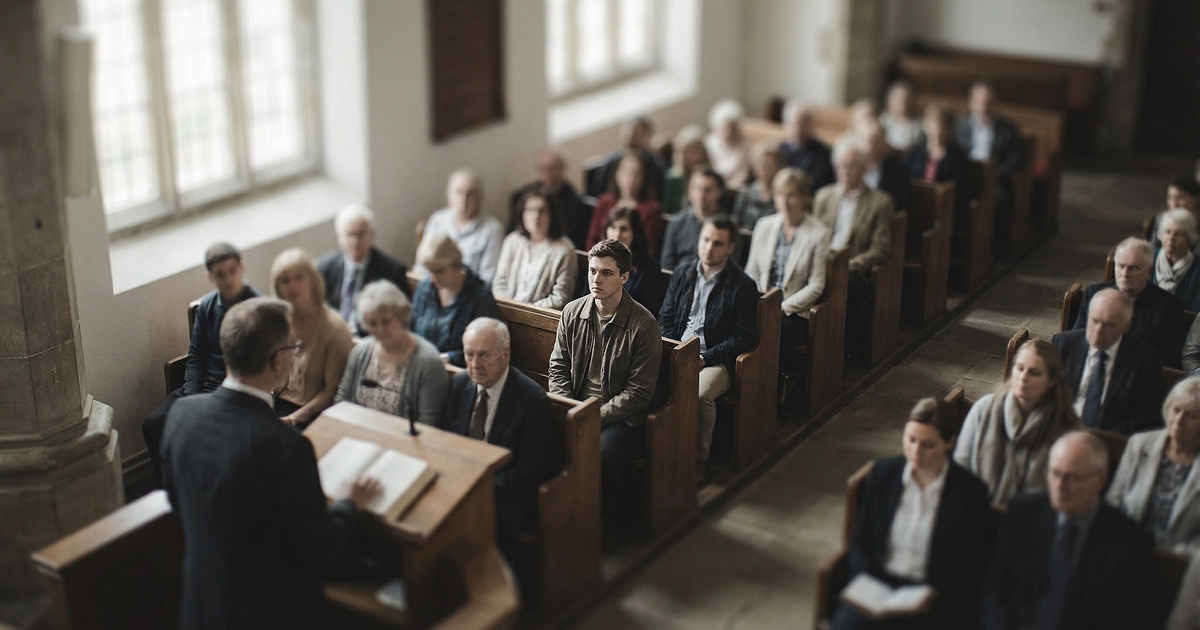
Yet preaching in the context of worship on the Lord’s Day is distinct from any other form of media. Indeed, preaching is a spiritual means of grace for the Christian.
I had a realization: What if, instead of listening to more good preaching on Sundays, I spent that time meditating on the preaching I'd already heard in-person? The sermon from my own pastor is rich enough that I could draw far more out of it—chew on it, pray through it, consider how to apply it to my life that week. I needed only to take a break from the constant stimulation of content and recover the old art of sermon meditation.
This shift has made a huge difference in my walk with Christ, and it's one of the reasons I’m so excited to be designing Velora.
We live, of course, in a content-driven age. Content is algorithm-sorted, on-demand, user-rated, and infinitely skippable. It's optimized for engagement. It succeeds when you click, watch, like, share, and come back for more. Content asks: What does the audience want?
This puts you in control. You decide what to consume, when to consume it, and how fast. Content is not a bad thing in and of itself. But over time, we've started treating sermons at church like just another piece of content. This, I believe, is a very big problem.
Preaching, on the other hand, is proclamation. When a pastor stands before a congregation and opens the Word, he is not performing for an audience, optimizing for engagement, or trying to go viral. He is speaking on behalf of God to God's people, in the context of the gathered church, as a means of grace that God has ordained.
This is why our spiritual forefathers spoke of preaching as a means of grace—one of the primary ways God shapes, corrects, comforts, and sanctifies his people.
"So faith comes from hearing, and hearing through the word of Christ." (Romans 10:17)
"Preach the word; be ready in season and out of season; reprove, rebuke, and exhort, with complete patience and teaching." (2 Timothy 4:2)
Preaching happens in a specific time, in a specific place, to a specific people. You can't skip it or even listen at 1.5x speed! The sermon is simply a sacred event through which (by faith) we receive true spiritual nourishment.
There's a reason God didn't give us a library of sermons and allow us to pick one that resonates with us on a given Sunday! Instead, he gave us the church—a local, gathered body of believers who sit under the same teaching, sing the same songs, confess the same sins, and break the same bread. And through the church, God has also given us pastors to shepherd our souls.
Your pastor may not have the polished delivery of speakers you hear at Christian conferences. He may occasionally stumble over words, run long, or belabor a point. But he knows you. He knows your community. He's walking with you through the same season and the same challenges. And when he preaches, he's not necessarily trying to captivate a global audience. He's trying to shepherd you.
That’s a level of personalization that no algorithm can replicate.
This doesn’t mean technology has no place in the life of the church, but it does mean we need to be thoughtful about what role our tech plays.
This is why we’ve designed Velora the way we have. There are plenty of wonderful apps that aggregate sermons from famous preachers and recommend the "best" ones based on your preferences and watch history. There’s nothing wrong with this, but we wanted to build something different—a tool that helps you stay present in your church, listening to your pastor, engaging with the sermon as it's being preached.
The Velora app helps you follow along with your pastor’s preaching. It transcribes and summarizes to complement your notes and enhance your ability to revisit key points later. Rather than asking Velora what the Bible says about a certain topic, our context-aware chat is designed for you to ask what your pastor has taught on that topic. Every design decision reflects our central conviction: The local church is irreplaceable.
We’re praying that our technology will be used to help Christians recover ancient paths, like going to church in-person as you are able, sitting under biblical preaching, and storing up that preaching in your heart and applying it in your life.
By all means, supplement this with solid teaching through podcasts and other media. Listen and read widely. Learn from the broader church. But above all, join a good local church and always keep its preaching ministry at the heart of your Christian life.
"And let us consider how to stir up one another to love and good works, not neglecting to meet together, as is the habit of some, but encouraging one another, and all the more as you see the Day drawing near." (Hebrews 10:24–25)